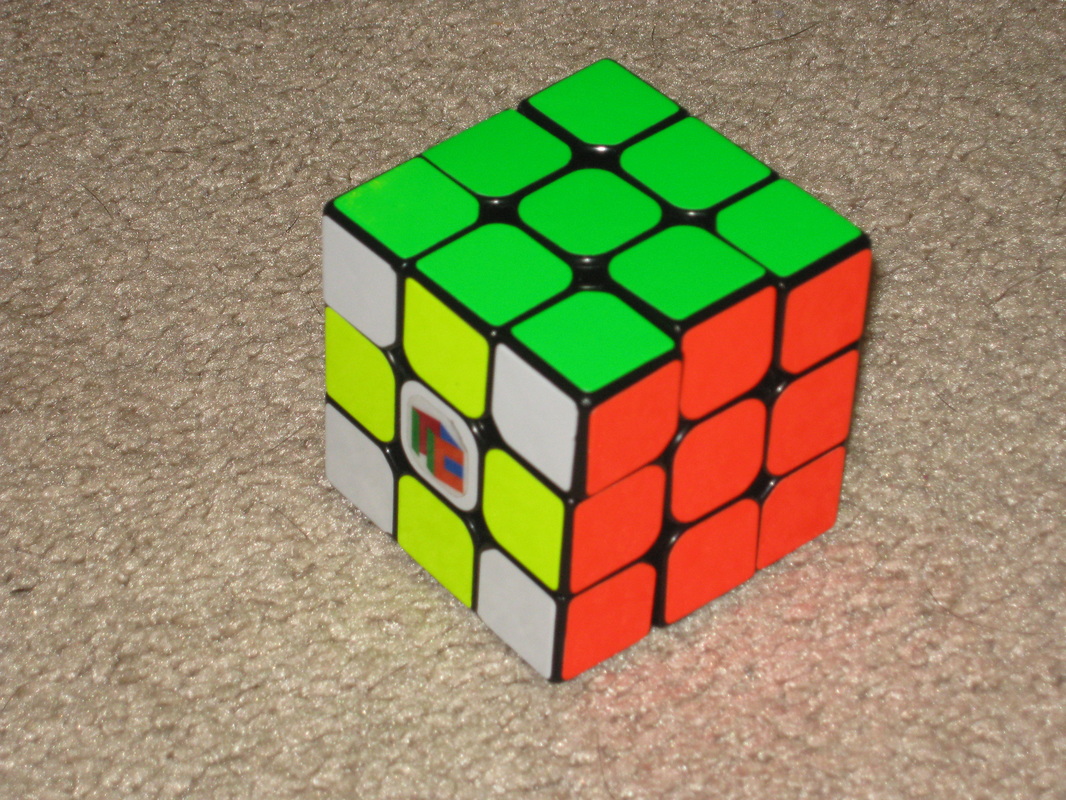
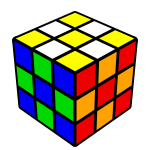
These cubes at SpeedCubeShop (and use discount code 'CUBEREVIEW' for 10% off your order Learn how to do a Basic Checkerboard pattern (0:13), a Flower Pattern (1:30), an Advanced Checkerboard (2:53), a Cube in a Cube (3:20) and the Superflip (5:35) on a 3x3, 4x4, 5x5, 6x6, 7x7, and so on! Find the algorithms at the bottom of the page at www.speedcubereview.com/pattern-algorithms.html Purchase.
» » Patterns Pretty Rubik´s Cube patterns with algorithms Are you tired of always the same way and you are looking for a new challenge? Software Compilazione 730 Gratis. Try to reproduce or invent!
In this section I´m going to present a gallery of pretty, preview images, and a small animation on how to form them. Find out how to make the famous, the checkerboard, the snake patterns, the cross, the cube in a cube and many other nice motives.
If you've got bored solving always the same way and you're looking for a new challenge try to reach one of these patterns without watching the algorithms supplied. You don't even have to know to be able to read the letters in the algorithms because I have attached a short animation for each scramble. If you don´t have a Magic Cube go ahead and use the or use the where you can apply rotations or even solve the cube online. Click or tap an image in the gallery to open and reveal the algorithm.
Make sure you check out of the list with more patterns! Click To Reveal The Patterns In The Gallery. X How to undo a scramble?
Apply the inverse rotations of the backward algorithm to revert the cube to the solved cube (or the initial position). Let's take a short algorithm for the demonstration, the Cross: U F B’ L2 U2 L2 F’ B U2 L2 U Written backwards: U L2 U2 B F’ L2 U2 L2 B’ F U Replace the moves with the inverse rotations: U’ L2 U2 B’ F L2 U2 L2 B F’ U’ – this will undo the Cross algorithm. Note that double rotations, marked with 2 are the inverse rotations of themselves because it doesn't matter in which direction you perform a half turn. Use this method to calculate the reverse moves for any pattern in the list.
Solution to the Pyraminx Solution to the Pyraminx Notation If you know the notation for the Rubik's Cube, the Pyraminx notation will be no problem. Each of the four corners is labeled as shown on the right. One-layer turns only affect the trivial tips, the little pyramidal pieces on the corners, so we won't use them for algorithms, but a one-layer turn of the R corner, for example, would be labeled as r (if it is a clockwise turn) or r' (if it was counterclockwise).
Similarly, a two-layer turn of the R corner would be labeled as R or R', and all of the other corners follow the same notation. There are two important types of pieces on a Pyraminx: the four corners (the pieces touching the trivial tips) and the six edges (the other pieces). Part 1: Four Corners and Two Edges The image on the left shows what we want to accomplish: we want to correctly orient all of the corners, solve all of the trivial tips, and also solve two edges. This seems like a difficult task, but it can actually be done very quickly. I would start by orienting three corners.
To do this, choose any color and find the three corners that have stickers of that color. Then, orient the corners so that those stickers are all on the same face. You will want to hold that face on the bottom for the rest of the solve. Now, to add the two edges, you will want to use moves of the form R U R', R U' R', R' U R, and R' U' R. Each one of these moves, along with U turns, will bring one edge to the bottom layer, and if you did the algorithm correctly that edge will be solved. Finally, orient the U corner with a turn, and fix all of the trivial tips. Once you get more experienced at the Pyraminx, you will be able to solve the bottom three corners and one edge (or even two edges) as one step, and you will be able to see how to do this during the 15 seconds that you have for inspection.
For example, if one edge is already paired up with one corner, it is always possible to solve a face so that that edge is in the correct position in that face. Part 2: The Last Four Edges The only things left to solve on the Pyraminx are four edges. Turn the entire puzzle as if you were doing some turn of U so that the unsolved edge on the bottom layer is in the front. Now there are 96 possible cases, of which only one is already solved. You will have to memorize all of these algorithms if you want to be able to do Part 2 in one step. Note that if more than one algorithm is listed you can freely choose any of them to learn and use.